
Active Moisture Management Below Living Spaces
Dehumidifier installation in Charleston for crawl spaces where encapsulation alone cannot control persistent coastal humidity
Coastal humidity in the Charleston area operates at a sustained intensity that passive moisture control cannot fully address on its own. Relative humidity in Lowcountry crawl spaces regularly measures between 50 and 90 percent across all four seasons—a range that promotes mold colonization on wood framing, accelerates fastener corrosion, and causes structural materials to swell and shift over time. First Class Crawlspace Solutions installs commercial-grade dehumidifiers sized and positioned specifically for crawl space conditions, integrated with vapor barriers and drainage systems to actively manage what the encapsulation system alone cannot eliminate.
Dehumidifier selection depends on crawl space volume and the existing moisture load at the time of assessment, not on a standard unit size applied to every job. A space with active drainage, a recently installed vapor barrier, and no standing water requires a different capacity unit than a crawl space that has been open to ground moisture for years and shows early wood decay. Placement also matters—positioning the unit to draw air from the most humid areas of the space, typically near exterior walls or drainage channels, determines how effectively it reduces ambient humidity to a stable, protective range. First Class technicians are licensed for this work, which affects both equipment selection and the warranty coverage tied to the installation.
Schedule a crawl space moisture assessment to determine what dehumidifier capacity and placement your specific space requires.
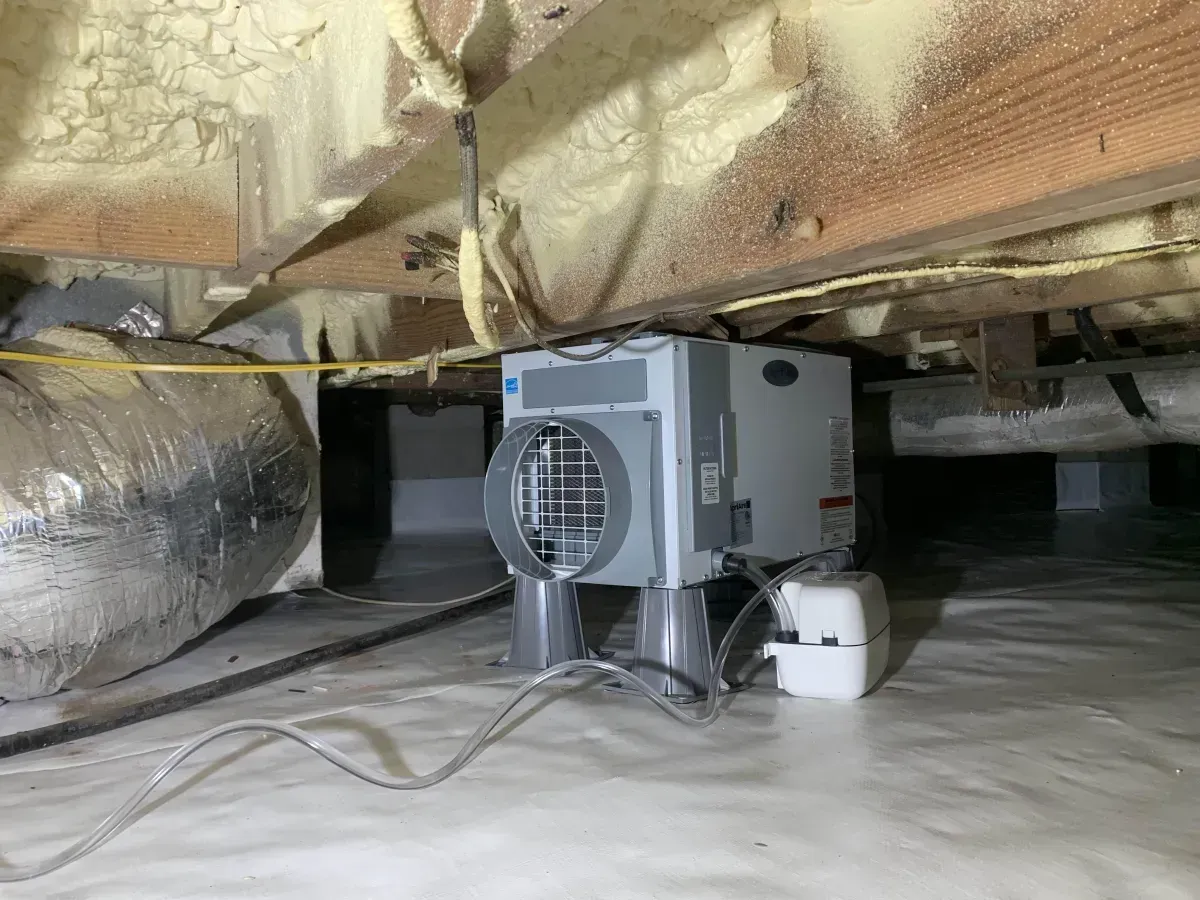
What Proper Dehumidifier Installation Requires
Installing a commercial crawl space dehumidifier involves more than placing a unit in an accessible location. The process includes evaluating the drainage path for condensate discharge—units must drain either to an existing sump system or through a gravity line to the exterior, and improper drainage routing allows collected water to reintroduce moisture into the space. Power supply requirements, including dedicated circuit capacity, must be confirmed before installation to avoid tripping breakers or underpowering the unit during high-humidity periods when the equipment runs most frequently.
Once a properly sized and positioned unit is running in a sealed crawl space, the humidity level drops to a measurable, stable range—typically below 55 percent—within a period determined by the starting moisture load and the size of the space. Wood framing that has been exposed to sustained high humidity will stop actively absorbing moisture, which halts the expansion-and-contraction cycle that contributes to floor squeaks and subfloor movement. First Class Crawlspace Solutions includes dehumidifier installation in approximately 80 percent of its encapsulation projects because passive sealing alone rarely achieves stable humidity control in this climate zone.
Ongoing performance depends on maintaining the unit according to the manufacturer's specifications—filter cleaning intervals, condensate line inspections, and periodic humidity readings confirm the equipment is operating within the range the space requires. Some crawl spaces benefit from a humidity monitoring system that provides readings without requiring a physical inspection, particularly in spaces with limited access clearance.
What Homeowners Usually Ask About Dehumidifiers
The decision to install a crawl space dehumidifier raises practical questions about equipment, maintenance, and whether the cost is justified for a specific property. The answers below address the most common decision points.
Why can't a standard household dehumidifier handle a crawl space?
Residential dehumidifiers are designed for conditioned living spaces and lack the drainage configurations, operating temperature range, and run-time capacity needed to manage a crawl space environment—most fail within one season under those conditions.
How is the right dehumidifier size determined for my crawl space?
Sizing is calculated based on cubic footage of the space, existing moisture readings taken at multiple points, and the vapor barrier and drainage conditions present—a unit installed without that assessment is frequently undersized and runs continuously without achieving target humidity levels.
What happens to mold risk if I encapsulate without adding a dehumidifier?
In the Charleston area's coastal climate, encapsulation without active dehumidification often reduces but does not eliminate humidity accumulation—mold can still colonize framing surfaces at sustained humidity levels above 60 percent even in a sealed space.
How often does a crawl space dehumidifier need servicing?
Most commercial-grade units require filter inspection every one to three months depending on dust levels in the crawl space, with a full service check annually to confirm drainage lines, refrigerant function, and electrical connections remain sound.
When is the best time of year to schedule installation in the Charleston area?
Installation can be completed year-round, but scheduling before the peak summer humidity season allows the system to be calibrated and confirmed operational before the months when moisture load is highest.
First Class Crawlspace Solutions carries the licensing and equipment knowledge to match the right commercial-grade unit to your crawl space conditions—call (843) 471-0920 to arrange an assessment and receive a specific equipment recommendation based on your property's moisture profile.